Top Benefits of Commercial Energy Audits
Audits reveal where buildings leak money and cut cooling costs, boosting savings, comfort, and equipment life.
Top Benefits of Commercial Energy Audits
A commercial energy audit can cut waste, lower utility bills, improve comfort, and help equipment last longer. For many commercial buildings, about 30% of energy use is wasted, and in Texas, summer cooling can drive 40% to 60% of the electric bill.
If I wanted the short version, here’s what I’d keep in mind:
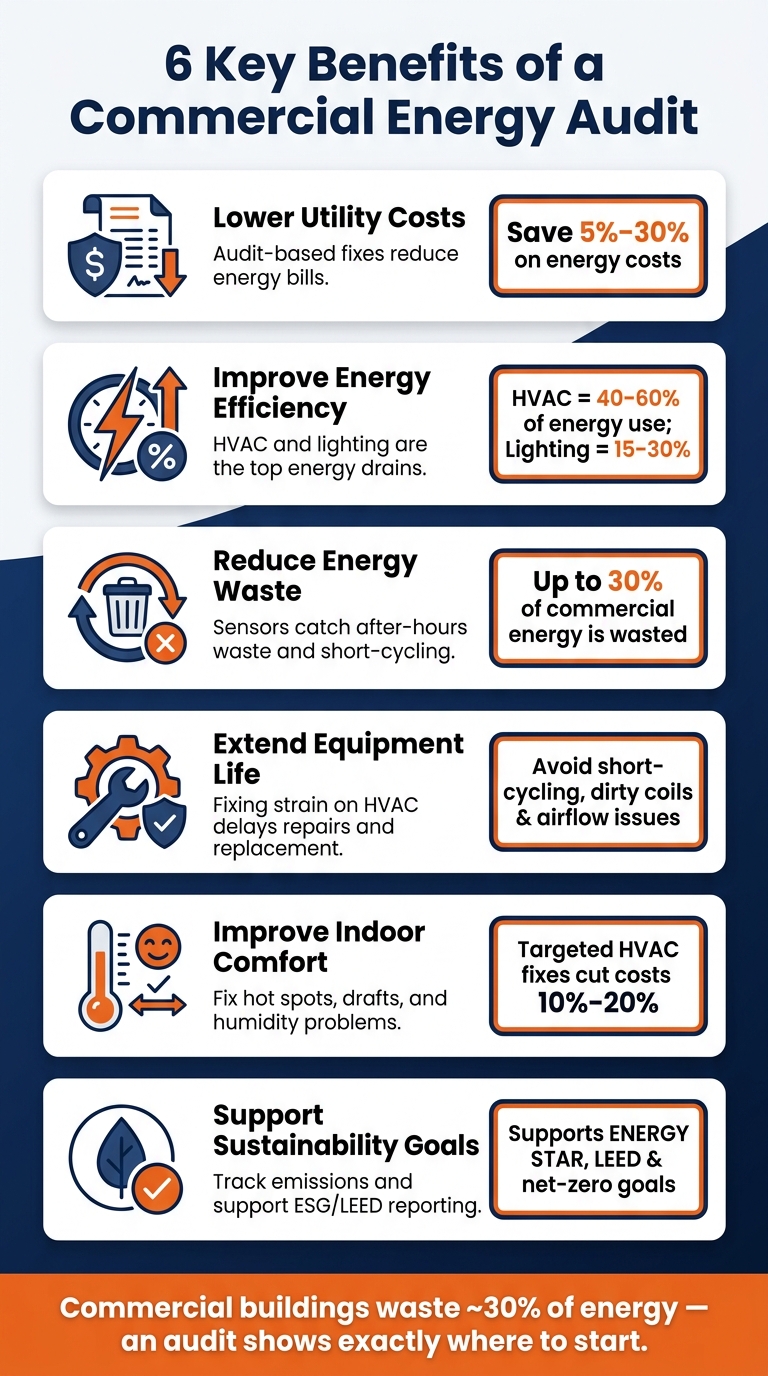
- Lower bills: audit-based fixes often cut energy costs by 5% to 30%
- Better efficiency: HVAC, lighting, and air leaks are usually the top problem areas
- Less waste: audits can spot after-hours run time, short-cycling, and weak controls
- Longer equipment life: fixing strain on HVAC systems can help delay repairs and replacement
- Better comfort: audits can help fix hot spots, drafts, and humidity issues
- Goal tracking: audit data can support ENERGY STAR, LEED, and reporting needs
A good audit does one simple thing: it shows where your building is losing money and gives you a ranked list of what to fix first. For business owners in Rockwall, that matters most when summer heat pushes HVAC costs up fast.
6 Benefits of Commercial Energy Audits: Savings, Efficiency & More
How to Improve Commercial Building Energy Efficiency - Without the Hype
sbb-itb-bbaa742
Quick Comparison
| Benefit | What it helps with | Common issue found |
|---|---|---|
| Lower utility costs | Smaller monthly bills | Poor HVAC schedules, drifted setpoints |
| Improve energy efficiency | Less energy used per square foot | Old lighting, constant-speed motors |
| Reduce energy waste | Less power used when no one needs it | Systems running after hours |
| Extend equipment life | Fewer breakdowns and less wear | Short-cycling, dirty coils, airflow problems |
| Improve indoor comfort | Fewer hot/cold spots and humidity complaints | Air leaks, bad balancing, weak ventilation |
| Support sustainability goals | Better tracking and reporting | High energy use intensity, old systems |
If you’re trying to control summer power costs, this is often the first step that makes the rest of the decisions easier.
1. Lower Utility Costs
In many Rockwall buildings, cooling eats up the biggest share of the utility bill. So it’s no surprise that lower monthly costs are often the first thing owners notice. A commercial energy audit breaks energy use down by system, which helps pinpoint the biggest cost drivers and sort out which fixes will pay off first. Common issues include dirty coils, fans running when they don’t need to, and setpoints that have drifted over time. Some of the fastest wins cost nothing at all. For example, reprogramming thermostat schedules alone can cut heating and cooling costs by 5% to 10%.
The numbers can move fast. Audit recommendations often reduce electricity bills by 5% to 30%, with median savings of 22% in one large study. Lower operating costs can also improve NOI and increase building value.
And here’s the part many owners like best: those savings often come from the same fixes that help the building run with less waste.
2. Improve Energy Efficiency
Lower utility bills start with a building that uses less energy. A commercial energy audit helps turn utility data into a clear action plan. It shows which systems are using the most power through bill analysis and an on-site inspection.
As Evan DeCotis of Colliers Engineering & Design notes, audits reveal current problems and future risks.
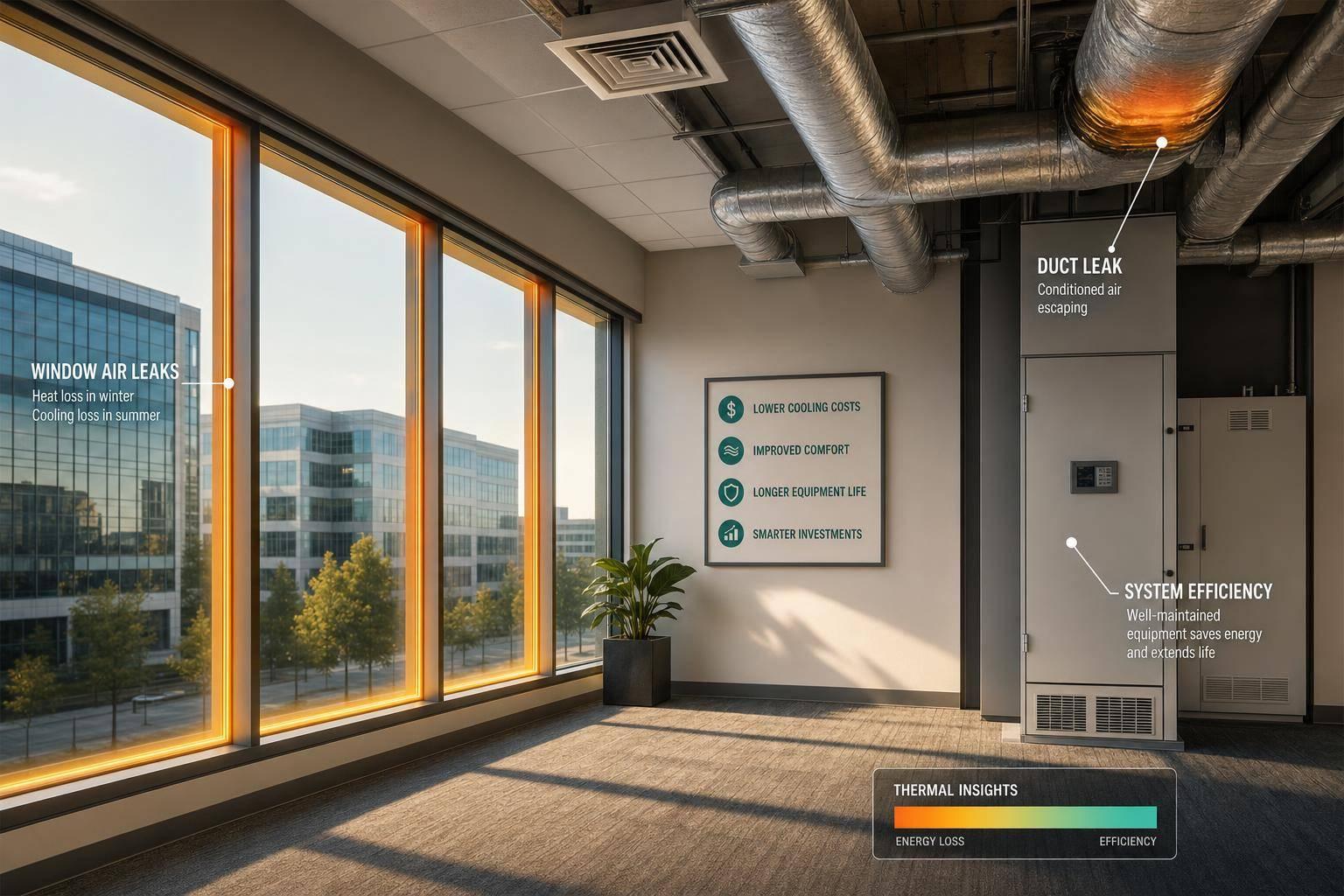
Auditors use tools like infrared cameras, blower-door tests, and airflow meters to spot issues that often slip by day to day. That includes heating and cooling running at the same time, plus air leaks that let conditioned air escape. In Rockwall and other cooling-heavy Texas markets, that kind of waste can get expensive fast.
The biggest savings usually come from a few key areas:
- HVAC tuning and controls
- Lighting retrofits
- Sealing walls, roofs, windows, and doors
HVAC systems often account for 40–60% of a commercial building’s total energy use, while lighting makes up 15–30%. That’s why those two areas tend to offer the biggest payoff. LED retrofits can cut lighting energy use by 40–60%, and Variable Frequency Drives (VFDs) on pumps and fans can reduce energy use by 20–50%.
Across many buildings, audit-backed upgrades lead to a 10–30% drop in annual energy use.
That drop in energy use also means less waste, which leads into the next major benefit.
3. Reduce Energy Waste
Commercial buildings can waste up to 30% of their energy. And most of that waste tends to come from the same trouble spots again and again.
That’s where an audit helps. Instead of relying on hunches, auditors put temporary sensors on major equipment and track how it performs over several weeks. This makes it easier to spot problems like systems running overnight in empty buildings or HVAC units turning on and off too often. They also check your building’s energy use per square foot, or EUI, against industry norms and similar facilities. If one system is using more energy than it should, that comparison usually brings it to light.
Here’s where hidden waste shows up most often:
| System | Common Waste Found | Potential Savings |
|---|---|---|
| HVAC | Oversized equipment, dirty coils, failed economizers, heating and cooling running at the same time | 15–40% of HVAC costs |
| Lighting | Outdated fluorescent lamps, no occupancy sensors or daylight harvesting controls | 30–70% of lighting costs |
| Building Envelope | Air leaks around docks/doors, missing insulation, single-pane windows | 5–15% of total energy |
| Plug Loads | Computers and printers running 24/7, inefficient "vampire" loads | 5–10% of total energy |
For Rockwall area businesses, the building envelope deserves a close look. Older commercial buildings can lose 30–50% of conditioned air. And when that air slips out through gaps, cracks, and weak insulation, your HVAC system has to work harder just to keep up. Professional air sealing can cut HVAC costs by 20–30%.
4. Extend Equipment Life
The same waste doesn't just drive up utility bills. It also wears equipment down faster. When a system runs with hidden problems, commercial equipment tends to fail sooner, repair bills climb, and replacement timelines move up before anyone planned for them.
One issue auditors often spot is short-cycling. That's when an HVAC compressor or refrigeration unit switches on and off too often. It can happen when equipment is too large for the space or when controls and sensors are out of calibration. Auditors also run into dirty coils, clogged filters, and airflow issues that put extra strain on fans and motors. Fixing short-cycling and airflow issues can help systems last longer, cut emergency repairs, and improve comfort.
Audits can also spot repeat repair trends by looking at 2–3 years of maintenance logs. If the same piece of equipment keeps showing up, that may point to energy waste at the root of the problem, not just bad luck or random failures. Retro-commissioning resets systems so they line up with how the building is used now. That often means fewer emergency repairs and more time before a major replacement is on the table. In Rockwall, a late-summer audit can catch HVAC wear when systems are working under the heaviest strain.
5. Improve Indoor Comfort
Comfort complaints often signal hidden energy waste. The same issues that drive up energy use usually show up first as uneven temperatures, drafts, and humidity problems. A commercial energy audit helps trace those symptoms back to the source.
Auditors use infrared cameras, airflow meters, and blower door tests to see what’s behind the discomfort. Infrared cameras can spot missing insulation and thermal bridges that cause drafts near walls and windows. Oversized equipment often short-cycles, which means it shuts off before it can remove enough humidity from the air. The result? Rooms feel clammy even when the thermostat says the temperature is fine. Taken together, these tests give owners a clear view of why people feel uncomfortable in the building.
One issue audits often find is a temperature imbalance, where one zone heats while another cools. Auditors also inspect economizers and dampers. A stuck economizer can trap stale air and cut ventilation. When those systems are balanced, the building feels better and uses less energy.
Fixing these problems affects day-to-day operations in a very direct way. Employees get more done, customers feel more at ease, and complaint calls drop. Targeted HVAC fixes can cut energy costs by 10% to 20% while improving comfort. That makes these fixes easier to compare based on impact, cost, and payback.
6. Support Sustainability Goals
Comfort and lower utility bills matter. But audits also give businesses a clear way to measure progress on sustainability goals.
An energy audit sets a baseline. From there, a business can turn broad goals into a practical plan for cutting emissions and tracking net-zero progress.
Poor scheduling, heating and cooling at the same time, and phantom loads all add to a building's carbon footprint. Audits point out which day-to-day habits and equipment problems drive the most emissions.
Audit data can also help with LEED, ENERGY STAR, and ESG reporting. And some upgrades may qualify for federal tax deductions.
For Rockwall businesses, audits make it easier to track progress and plan future upgrades without interrupting daily operations. That gives teams a simple way to compare sustainability gains with cost savings, comfort, and equipment life.
Side-by-Side Comparison Table
This table gives you a plain-English way to compare the main audit benefits, what they can mean for the business, and which systems usually need work first.
| Benefit | Business Impact | Common Audit Finding | Building Systems Involved |
|---|---|---|---|
| Lower Utility Costs | Higher NOI and lower annual energy use | Outdated lighting fixtures; high peak demand charges | Lighting, HVAC, Controls |
| Improve Energy Efficiency | Lower energy use per square foot and lower operating costs | Constant-speed fans and pumps; oversized HVAC units without VFDs | HVAC, Motors (VFDs), mechanical and electrical equipment |
| Reduce Energy Waste | Less waste and lower carbon footprint | Simultaneous heating and cooling; lights left on in unoccupied zones | Controls, Lighting, Equipment Scheduling |
| Extend Equipment Life | Lower maintenance costs and deferred capital replacement | Short-cycling compressors; drifted sensors; fans running at full speed unnecessarily | HVAC, Controls, Mechanical Systems |
| Improve Indoor Comfort | Higher tenant retention and productivity | Air leaks; leaky ductwork; poorly calibrated thermostats | HVAC, Building Envelope, Insulation |
| Support Sustainability Goals | ESG reporting support and LEED/ENERGY STAR alignment | High EUI compared to industry benchmarks; lack of renewable-energy integration | All building systems |
The patterns here help you rank upgrades by payback. In most cases, that means starting with the fixes that cost less, save more, and solve problems across more than one system at the same time.
Next Steps for Business Owners in Rockwall
Start with the data you already have. Pull together 12 months of electric and gas bills so you can spot seasonal swings, spikes, and demand charges. Peak demand spikes may last just 15 minutes, but they can make up 30–50% of a commercial electric bill. If you can’t explain why usage changed, that’s a strong place to begin the audit.
Next, line up those bills with what people are dealing with inside the building. Compare utility costs with HVAC maintenance logs and any comfort complaints from staff or tenants. If high-usage periods match equipment errors, short-cycling, or uneven temperatures, you’ll have a much better sense of where the problem sits. It also makes sense to review your default rate plan. A lot of businesses stay on plans that don’t fit their actual load profile.
Then do a quick walkthrough on your own. Look for simple issues like:
- Lights left on in empty rooms
- Damaged weatherstripping around doors
- Thermostats set too high or too low
Bills show cost. Maintenance logs show waste. Comfort complaints show where savings and building performance problems meet. Make a short list of trouble spots, then ask auditors whether the ASHRAE level matches your goals, whether they hold a Certified Energy Manager (CEM) or Certified Energy Auditor (CEA) credential, and whether the report ranks fixes by payback and ROI. That helps you get to a cleaner, faster audit.
Conclusion
For Rockwall businesses dealing with brutal summer cooling bills, speed matters. A commercial energy audit takes those monthly utility costs and turns them into a clear action plan. Instead of guessing, owners get a ranked list of fixes, from no-cost changes to bigger upgrades they can phase in over time.
The upside can be big. Commercial buildings waste roughly 30% of the energy they use, which means a business can lose about 30% of its utility spend to inefficiency. And when upgrades are based on audit findings, they typically cut energy use by 10% to 30%.
An audit also brings hidden issues into the open. It can spot current problems and future risks, help protect equipment, improve comfort for staff and customers, and support certifications like LEED and ENERGY STAR.
That’s why simple action taken early often leads to the best audit results. For Rockwall owners, a smart place to begin is with recent utility bills, a short list of pain points, and a Level 1 walk-through audit. Starting near $500, that first step can reveal quick wins that help pay for bigger improvements later.
FAQs
What happens during a commercial energy audit?
A commercial energy audit looks at how a building uses energy, where that energy is being wasted, and which changes are most likely to pay off.
It usually starts with a review of utility bills, maintenance logs, and building schedules. That gives the auditor a baseline, so they can see how the building is performing before suggesting any changes.
From there, auditors inspect systems such as HVAC, lighting, and insulation. They often use testing tools to check actual performance instead of relying only on assumptions or past records.
You’ll then get a customized report that lays out the best energy-saving opportunities in order of priority. It also includes a cost-benefit analysis and an implementation roadmap, so you can see what to do first, what it may cost, and where the return is likely to come from.
How do I know which audit fixes to do first?
Your auditor will give you a ranked list of Energy Conservation Measures based on your goals, return on investment, project complexity, and implementation timeline.
Use the audit report’s cost-benefit analysis and payback estimates to spot the fixes that can cut costs the fastest and deliver the best long-term return.
How much can a Rockwall business save with an energy audit?
Rockwall businesses can often cut annual energy use by 10% to 30% by acting on audit recommendations. The exact amount depends on the building type and how much is invested, but total savings can land anywhere from 20% to 50%.
And it doesn’t always take a big retrofit to start seeing results. Even without major upgrades, many businesses get immediate savings of 5% to 20% from low-cost operating changes and basic efficiency fixes.
Related Rockwall Businesses
-
Lead Fuel CRM
Your Entire Business in One App. Phone, email, text, invoicing, contracts, automation, AI, websites, funnels, reviews, s
-
PxlPerfect Designs
At PxlPerfect Designs, we believe in more than just websites and SEO - we believe in helping businesses grow, supporting
-
Cards on the Harbor
Cards on the Harbor is Rockwall's collector store for verified Pokemon singles, rare vintage foils, and factory-sealed b