Customer-Centric Trends for Rockwall Businesses 2026
Rockwall businesses win by removing friction: be easy to find, easy to contact, clear on price, fast on mobile, and active with reviews.
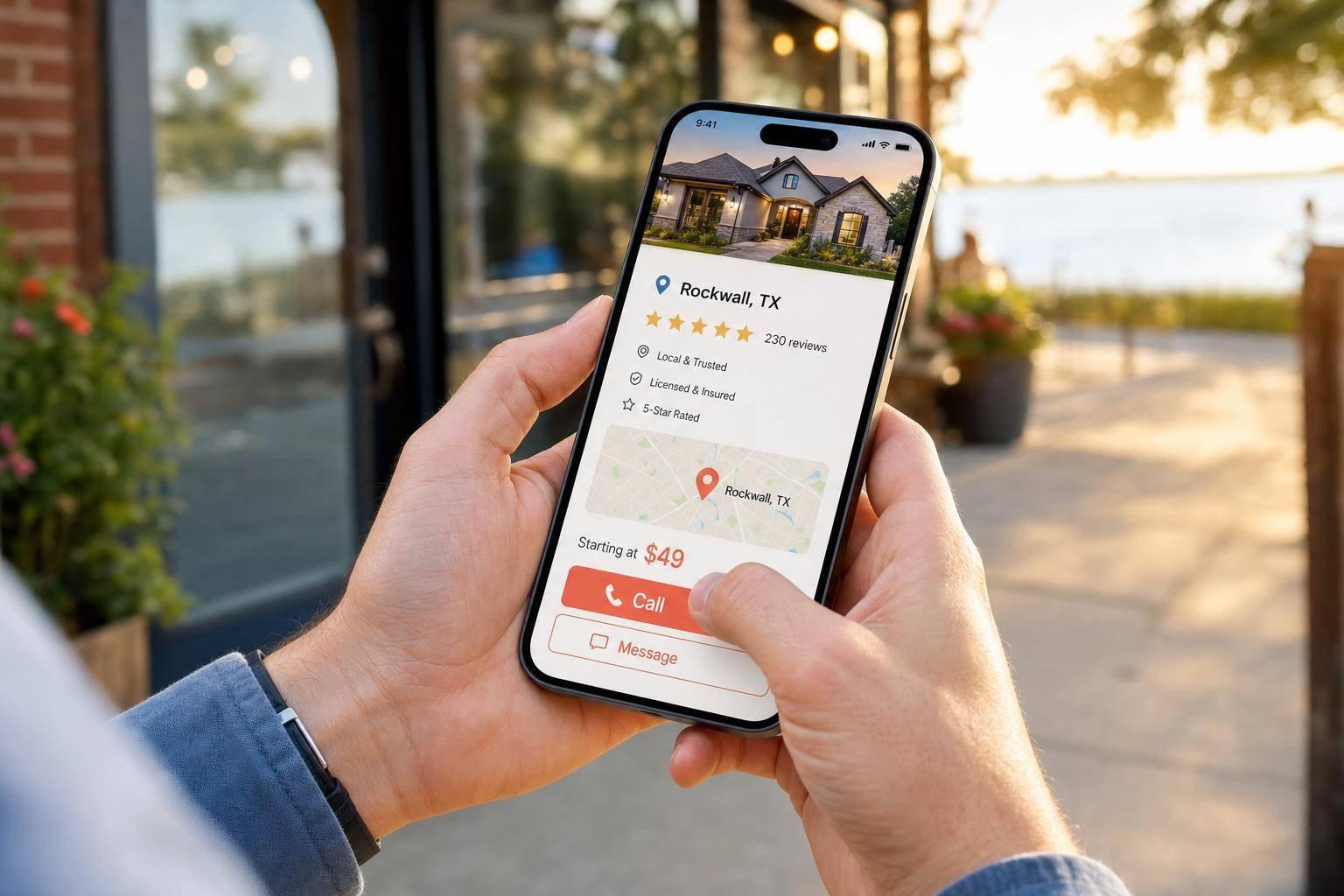
Customer-Centric Trends for Rockwall Businesses 2026
In 2026, I see one clear pattern: Rockwall businesses win when they are easy to find, easy to contact, and clear about price. Customers now expect near-instant answers, mobile-friendly service, and public proof that a business follows through. When 42% of customers say their service expectations went up since 2024, slow replies and vague pricing cost sales.
Here’s the short version of what matters most:
- AI and search changed local discovery. More people now use AI tools for local picks, and many Google searches end without a website click.
- Personal service still matters. 71% of consumers expect personalized interactions, even from small local businesses.
- Clear pricing builds trust. Hidden fees and vague quotes turn people away.
- Mobile is now the main path. More than half of shoppers use mobile as their main online experience.
- Reviews shape first impressions. Many buyers now filter out businesses under 4.5 stars.
What I’d focus on first:
- Fix Google Business Profile, website info, and business listings
- Reply to leads the same day
- Show pricing and estimates in plain language
- Make booking, calling, and paying easy on mobile
- Ask for reviews after each job or visit
| Trend | What customers want | What I’d do |
|---|---|---|
| AI search | Up-to-date business info | Keep listings, hours, photos, and services current |
| Personalization | Service that feels relevant | Use reminders, follow-ups, and simple customer notes |
| Price clarity | No surprise fees | Share itemized estimates before work starts |
| Mobile-first service | Fast phone-based actions | Add tap-to-call, mobile forms, and text updates |
| Reviews | Proof from other buyers | Ask for reviews and reply fast |
This article comes down to a simple idea: if I remove friction at each step, I make it easier for Rockwall customers to choose me and come back.
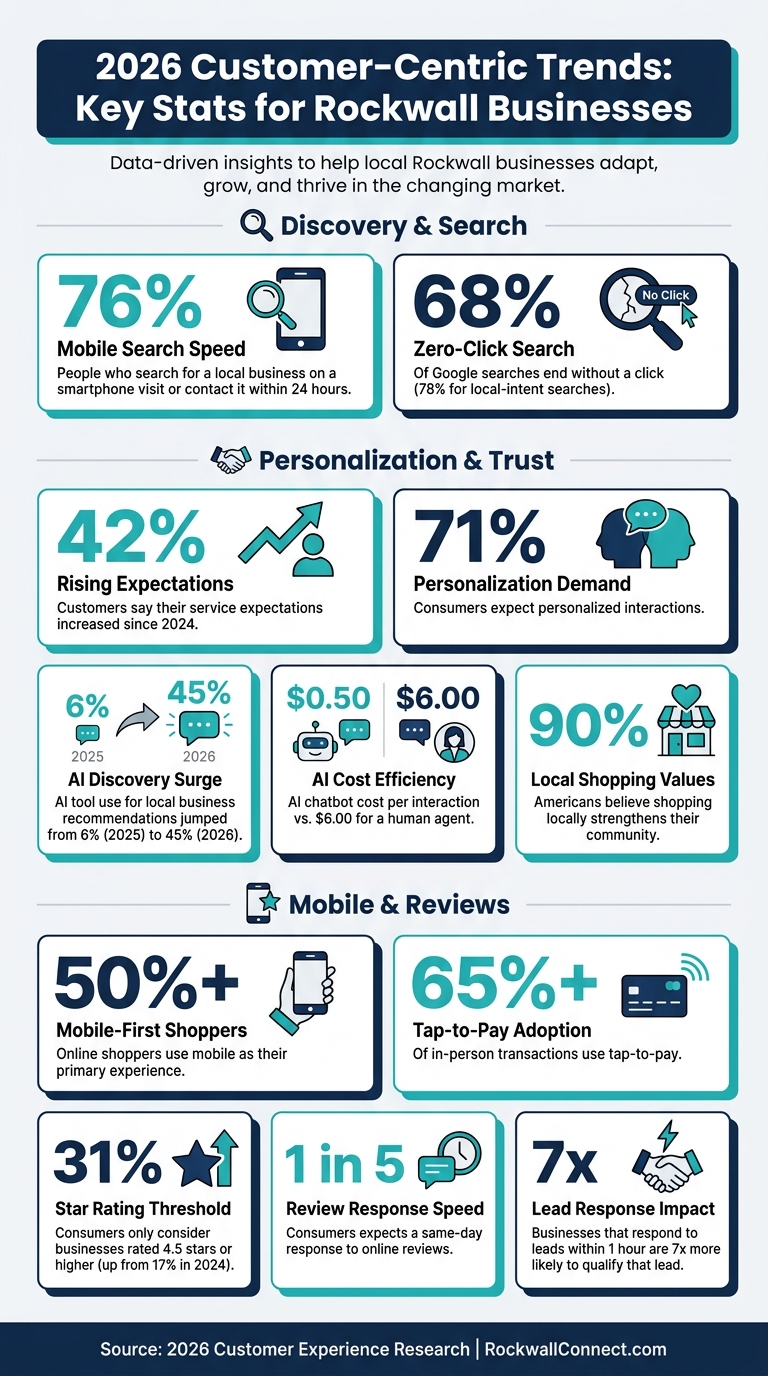
2026 Customer-Centric Trends: Key Stats Rockwall Businesses Need to Know
"Top 10 Customer Experience Trends You NEED to Know in | CX Strategy Guide"
sbb-itb-bbaa742
The Customer-Centric Foundations Every Small Business Needs
Start with the friction customers feel first: a slow website, a missed call, or prices they can't find. Fix those gaps first. That's often the line between a business that grows and one that stalls. When pressure builds, the basics matter even more.
Map the Full Customer Journey From Search to Repeat Business
Map every step: search, response, booking, service, and follow-up.
76% of people who search for a local business on a smartphone visit or contact it within 24 hours. So your first impression is usually digital, not in person.
For Rockwall residents, discovery often starts on Google or RockwallConnect.com, where they look for trusted local businesses and community updates. If your listing shows old hours or leaves out a phone number, the journey can end right there. Your Google Business Profile, website, and social pages need to match. When hours or pricing don't line up, people notice fast, and trust drops fast too.
A lot of small businesses slip at the follow-up stage. That's a missed chance. Send an automatic thank-you after service, along with a short feedback request. It's a simple move, and it helps bring people back.
How to Use Customer Data Without Losing Trust
Once you've mapped the journey, data should help you reply faster and make the experience feel more personal.
You don't need a big tech budget for this. Reviews, appointment history, and purchase patterns already tell you a lot. Use the signals you have to make your timing better and your service more relevant.
79% of consumers will stop interacting with a brand they don't trust to protect their data. People can tell when data is handled carelessly. Keep it simple:
- Use opt-in messaging
- Say what you collect
- Don't use customer data in ways that feel intrusive
A Rockwall HVAC reminder before peak summer heat feels helpful, not intrusive. A random promo out of nowhere feels like too much.
Businesses that excel at personalization can boost revenue by 40%. At the local level, that can look pretty simple. A restaurant that remembers a regular's dietary preference stands out. So does a home services company that flags an annual maintenance window before the customer has to think about it.
Business-First vs Customer-First Decisions
A lot of friction comes from internal rules customers never see. Maybe your hours are set around staff convenience. Maybe pricing only makes sense after a phone call. Maybe booking only works during business hours. Those are business-first choices dressed up as normal operations.
Here's a blunt way to test it: if a customer watched your internal decisions for a week, would they feel like the point of the business, or just the person moving through it?
Use this quick test to spot where operations favor the business over the buyer.
| Area | Business-First Approach | Customer-First Approach |
|---|---|---|
| Access | Set based on staff convenience | Flexible access or self-service booking options |
| Clarity | Vague "starting at" rates with hidden fees | Clear, itemized estimates and transparent structures |
| Speed | Slow callbacks or "we'll get to it next week" | Instant confirmations and same-day responses |
| Convenience | Phone-only during restricted business hours | Seamless online booking and 24/7 digital inquiry |
| Recovery | Defensive or silent when errors occur | Proactive updates before the customer notices |
Transparent pricing is both a legal requirement and a trust signal. For Rockwall businesses, clear estimates and honest fees are the baseline.
The 5 Customer-Centric Trends That Matter Most in 2026
With the basics in place, these five shifts now shape how Rockwall customers choose, buy, and come back.
AI Search, Faster Service, and Easier Buying
The way people find local businesses changed fast. Use of AI tools like ChatGPT for local business recommendations jumped from 6% in 2025 to 45% in 2026. At the same time, 68% of Google searches now end without a click - rising to 78% for local-intent searches. So your business can't just be a blue link anymore. It needs to be the answer that shows up first.
When Rockwall residents look for a restaurant, HVAC company, or local hangout, AI tools and Google pull from the information they can find right now. That's why your listing on RockwallConnect.com and your Google Business Profile need to stay accurate. Update your hours, services, and photos on a regular basis so search tools keep showing current details instead of old ones.
AI chatbots are also becoming a practical choice for local businesses. They now handle routine FAQs at about $0.50 per interaction, compared to $6.00 for a human agent. For a Rockwall HVAC company or a local salon, that kind of 24/7 coverage can catch leads that might otherwise slip away overnight. Use AI for speed, then hand off the tougher issues to a real person.
Once customers can find you fast, the next step is making the experience feel personal.
Personalization, Community Connection, and Shareable Local Content
71% of consumers expect personalized interactions. In Rockwall, that doesn't have to mean fancy software or a giant budget. It can be as simple as remembering a regular order, sending a service reminder, or sharing a local tip that feels useful instead of generic.
Local businesses also have an edge that big chains can't fake. 90% of Americans believe shopping locally strengthens their community. That's a big deal. People want to feel tied to the place where they spend their money.
Share content that helps Rockwall residents in everyday life. That could mean road closure updates, local event tie-ins, or money-saving tips people will want to send to a friend. Short-form video is now the #1 ROI-driving content format for local discovery. A quick behind-the-scenes clip or a short local tip can go a long way. If posting feels like a chore, batch-create once a week and keep it simple.
From there, pricing clarity often becomes the last filter between interest and purchase.
Price Transparency, Value, and Trust Signals
The FTC's 2025 rule targeting hidden "bait-and-switch" fee tactics pushed upfront pricing even further into the customer experience conversation. In plain English: people want the full price before they commit, not a surprise at checkout.
| Area | Traditional Approach | 2026 Customer-Friendly Approach |
|---|---|---|
| Fee Structure | Hidden fees added at final checkout | All-in pricing shown upfront |
| Estimates | Vague verbal or lump-sum quotes | Itemized digital estimates with audit trails |
| Compliance | Risk of FTC "bait-and-switch" violations | Aligned with FTC Rule on Unfair or Deceptive Fees |
| Communication | Reactive; silence after errors | Proactive updates before the client notices a gap |
| Trust Signal | Feels deceptive | Positions the business as a transparent partner |
Pricing is only part of the picture. Trust signals also include recent reviews, the way you reply to feedback, and updated business photos. In 2026, a business with steady, current feedback looks far more trustworthy than one with stale reviews or no public replies at all.
After price comes convenience, and for most people, that convenience lives on their phone.
Mobile-First Communication and Self-Service Options
Most customers now start and finish on mobile. Over 50% of online shoppers now use mobile as their primary experience, and a slow or clunky mobile site can feel like a locked front door.
For busy Rockwall families and commuters replying between errands or after work, the checklist is pretty short:
- Tap-to-call buttons that work
- Mobile-friendly forms
- Text-based updates for appointments and service windows
Tap-to-pay now accounts for over 65% of in-person transactions. If checkout drags, sales can disappear fast. Use Google PageSpeed Insights to spot and fix the load issues pushing mobile users away.
The last big trust test is public reputation, where reviews shape first impressions before a customer ever reaches out.
Reviews, Reputation Management, and How You Respond in Public
31% of consumers will only consider a business rated 4.5 stars or higher - up from 17% in 2024. That means a business sitting at 4.2 stars is now invisible to nearly a third of potential customers before they ever visit the website.
Asking for reviews works best when the process is automatic and the timing is right. Aim for at least 15 new reviews per month to keep recency signals active. In Rockwall, people check recent feedback before they pick a plumber, salon, contractor, or restaurant, so fresh reviews matter just as much as the star rating.
1 in 5 consumers expects a same-day response to their online reviews. And public replies matter just as much as the rating itself. A calm, professional response that uses the customer's name and offers a fix shows future customers that your business takes problems seriously. Ignoring complaints, or replying in a combative way, sends the opposite message.
It also helps to keep your business details current across every platform. Old hours or the wrong phone number on a review profile can chip away at trust before the first conversation even starts.
How Rockwall Business Owners Can Put These Trends to Work
Restaurants, Retail, and Service Businesses: Fast Local Wins
These are the fastest fixes for businesses that depend on local search and quick checkout. For Rockwall restaurants, shops, and service businesses, that means showing up when people are searching, comparing options, and ready to buy.
Keep your profile active with one new photo or update each week. Top-three Map Pack listings drive far more calls and visits than lower-ranked results.
If you run a restaurant or retail shop, add online ordering with in-store pickup if you haven’t done it yet. That setup can lead to more in-store sales: 85% of BOPIS shoppers make an unplanned extra purchase when they come in for pickup. Pair that with tap-to-pay so checkout moves faster during busy hours.
Short videos can help here too. Post clips tied to Rockwall events, road updates, seasonal specials, and simple money-saving tips people may pass along.
Home Services and Professional Practices: How Clarity Builds Loyalty
For service businesses, trust comes from speed, clear communication, and fewer surprises.
For HVAC companies, plumbers, electricians, landscapers, and professional practices, trust is the product. One of the biggest weak spots right now is pricing. The FTC rule effective May 12, 2025 requires businesses to present full pricing structures upfront. In plain English, that means itemized written estimates before work starts, not one lump-sum number after the job is done. If the scope changes, call it out before billing so you don’t leave a misleading impression that hurts trust.
Silence after a problem often costs more trust than the problem itself.
Speed matters just as much as price clarity. Businesses that contact a lead within one hour are seven times more likely to qualify that lead than businesses that wait longer. Even a basic auto-reply on your web form helps. A note like, "We got your request and will call you within two hours" sets expectations and keeps silence from becoming the issue.
A 90-Day Plan to Improve Your Customer Experience
Use this plan to turn the trends above into weekly action.
- Days 1–30: Fix the front door. Audit your Google Business Profile for accuracy: hours, phone number, photos, and service descriptions. Check your listing on RockwallConnect.com alongside Google and your website so your details match everywhere. Make sure your site loads in under three seconds on mobile. These are the issues that quietly push customers away before they ever reach out.
- Days 31–60: Build your reputation system. Set up an automated review request that goes out right after a completed service or purchase. Reply to every review within 24 hours, use the customer’s name, and mention something specific about their experience. Keep all customer messages in one place.
- Days 61–90: Shift from transactional to personal. Start collecting first-party data, like email and SMS opt-ins, so you can reach customers directly. Use email and text for reminders, seasonal offers, and repeat visits. Track four numbers to measure progress: Net Promoter Score (NPS), Customer Satisfaction Score (CSAT), First Response Time, and customer retention rate.
"The businesses that are growing their lead volume from digital in 2026 are doing fewer things with more intention, not more things with more budget." - Creasions
Use an impact-versus-effort filter across all three phases. Start with the fixes customers feel first: speed, clarity, and easy contact.
Conclusion: What Rockwall Businesses Should Focus on Next
These five trends point to one simple rule: Rockwall businesses need to be easy to find, easy to buy from, and clear about what they offer. The businesses that win are the ones that cut friction at every step.
In 2026, a better customer experience doesn’t come from pricey software. It comes from doing the basics well: keeping your Google Business Profile current, running a fast mobile site, showing pricing upfront, and replying the same day. Those simple moves do most of the heavy lifting.
Why do these basics matter so much? Because trust still shapes local decisions. People in Rockwall want clear info, fast answers, and businesses that feel connected to the community. That’s not new. What’s changed is that customers now have far less patience for businesses that get the small stuff wrong.
RockwallConnect.com helps local businesses stay visible to residents who are searching, checking updates, and looking for trusted options in Rockwall.
FAQs
How can I improve customer experience on a small budget?
Improving customer experience on a small budget comes down to consistency, clear communication, and a few simple tools.
Automate routine tasks where you can. Use low-cost CRM tools to handle follow-ups, and make sure your website is mobile-friendly, fast, and current. Those small fixes can make a big difference in how people feel about doing business with you.
When customers leave feedback, reply fast. Be upfront about pricing. And instead of spending all your energy chasing new leads, put some focus on keeping the customers you already have through personal service that feels human, not canned.
For Rockwall businesses, regular social media posts and local community involvement can help build trust without big marketing spend.
Which trend should Rockwall businesses prioritize first?
Rockwall businesses should start with a strong digital base: their Google Business Profile, active review management, and local search optimization.
A lot of people check reviews before they visit a business. And many want to see at least a 4.5-star rating before they feel good about going. That makes your online reputation one of the first things people judge.
Once that’s in place, the next step is simple: make sure your online presence matches the experience people get in person. If your hours, photos, service details, and tone feel aligned with what happens in-store, trust comes a lot easier.
How do I make my business easier to find locally?
Prioritize your Google Business Profile as your main digital storefront. Fill out every field, choose the right service categories, and keep it active with regular updates and new photos.
Your name, address, and phone number should match exactly across your website, social media profiles, and RockwallConnect.com. On top of that, make sure your site works well on mobile and keep asking for customer reviews. When reviews come in, respond to them. It shows people you're paying attention.
Related Rockwall Businesses
-
Lead Fuel CRM
Your Entire Business in One App. Phone, email, text, invoicing, contracts, automation, AI, websites, funnels, reviews, s
-
PxlPerfect Designs
At PxlPerfect Designs, we believe in more than just websites and SEO - we believe in helping businesses grow, supporting
-
The Mailbox Marketplace
The Mailbox Marketplace is a locally owned advertising company created to help small businesses connect with customers i