How To Do a 401k Rollover in Dallas Texas
Step-by-step guide to rolling over a 401(k) in Dallas, TX—choose an IRA or new 401(k), avoid taxes and penalties, use direct transfers, and find local advisors.

How To Do a 401k Rollover in Dallas Texas
Rolling over a 401(k) in Dallas, Texas, involves transferring your retirement funds from a previous employer’s plan to an IRA, a new employer’s 401(k), or another qualified account. Here’s a quick guide to the process:
- Choose Your Rollover Destination: Options include a Traditional IRA, Roth IRA, or your new employer’s 401(k). Each has its own tax rules and benefits.
- Understand Tax Rules: Texas has no state income tax, so you’ll only deal with federal taxes. Direct rollovers avoid immediate tax withholding.
- Gather Necessary Documents: Have your 401(k) statements, account numbers, and plan administrator details ready.
- Decide on a Transfer Method: Opt for a direct rollover to avoid tax penalties. Indirect rollovers require replacing withheld taxes within 60 days.
- Open a New Account: Set up your IRA or confirm your new employer’s plan accepts rollovers.
- Request the Transfer: Contact your old plan administrator to initiate the rollover.
- Invest Your Funds: Once the transfer is complete, allocate your funds to meet your retirement goals.
Avoid common mistakes like cashing out early or missing the 60-day deadline for indirect rollovers. Local financial advisors in Dallas and Rockwall can help navigate the process and ensure compliance with IRS rules.
401(k) Rollover Explained: Avoid Costly Mistakes with This Guide
Your 401(k) Rollover Options
When you leave your job, you’ve got five main choices for handling your 401(k) funds. First, you can roll the money into a Traditional IRA, which lets your savings continue growing tax-deferred without any upfront tax hit. Another option is a Roth IRA rollover - this requires paying taxes now, but your money grows tax-free, and withdrawals in retirement won’t be taxed. If your new employer allows it, you can transfer your funds into their 401(k) plan, which can simplify managing your retirement accounts and might even give you access to employer matching. Alternatively, you could leave the funds in your old 401(k) if your former employer permits it, though you won’t be able to make additional contributions. Lastly, there’s the cash-out option, but beware: this triggers federal taxes and a 10% penalty if you’re under 59½.
Where You Can Roll Over Your 401(k)
Each rollover destination comes with its own set of benefits. For example, Traditional IRAs offer more investment options, such as individual stocks, bonds, ETFs, and even real estate. On the other hand, 401(k) plans tend to have a narrower selection, primarily mutual funds, but they provide better creditor protection under federal ERISA laws. IRAs generally only offer bankruptcy protection, capped at around $1 million.
Another key difference lies in required minimum distributions (RMDs). If you’re still working past age 73, you can delay RMDs for your current employer’s 401(k). However, Traditional IRAs require RMDs starting at 73, regardless of your employment status. Here’s another thing to think about: if you leave your job in or after the year you turn 55, you can withdraw from that 401(k) without paying the 10% early withdrawal penalty - a perk you lose if you roll those funds into an IRA.
"If you roll 401(k) funds into your IRA, you lose the ability to withdraw funds penalty-free at 55." - Byron Ellis, Financial Planner, Goldman Sachs Personal Financial Management
Once you’ve decided where to roll over your funds, the next step is figuring out the best way to transfer them.
How to Transfer Your Funds
Choosing the right transfer method is crucial. A direct rollover, also known as a trustee-to-trustee transfer, is the simplest and safest option. In this process, your old plan administrator sends the money directly to your new retirement account provider, which bypasses any tax withholding.
An indirect rollover, on the other hand, works differently. Here, you receive a check made out to you, but the IRS automatically withholds 20% for federal taxes. To avoid taxes and penalties, you’ll need to deposit the full amount - including that withheld 20% - into a new qualified account within 60 days. If you miss that deadline, the entire distribution becomes taxable income, and if you’re under 59½, you’ll also face a 10% early withdrawal penalty.
"How you transfer your IRA or 401k accounts can have a huge impact on whether or not the money is taxable." - DFW Retirement Planners
IRS Rules and Texas Tax Benefits
The IRS has strict guidelines for rollovers, especially indirect ones. The 60-day rule is non-negotiable - miss the deadline, and you’ll owe taxes on the full amount, plus potential penalties. There’s also a one-rollover-per-year rule, which limits indirect IRA-to-IRA rollovers to once every 12 months. However, this rule doesn’t usually apply to 401(k)-to-IRA transfers.
For those in Dallas or elsewhere in Texas, there’s a bit of good news: Texas doesn’t have a state income tax. That means you’ll only need to worry about federal tax obligations when managing your rollover.
Getting Ready for Your Rollover
Documents and Information You'll Need
Start by gathering all the necessary paperwork. You’ll need the latest 401(k) statement from your former employer to confirm your account balance and to check whether your funds are pre-tax or Roth. Be sure to have your plan administrator’s contact information - this could be a phone number, email, or website - along with the account number and exact account name for your new IRA or 401(k). If you have an outstanding 401(k) loan, take a close look at your plan’s rules. Many plans require these loans to be paid off before you leave your job; otherwise, the loan may be classified as a taxable distribution. For those participating in Texas municipal plans like Texa$aver, ensure you meet a qualifying condition, such as retirement or separation of service, before moving forward. Once all your documents are in order, you’re ready to explore your rollover options.
Comparing Your Rollover Options
After understanding where your funds can go, it’s time to compare the specifics of each option. Fee structures can vary widely. Large employer-sponsored 401(k) plans often have lower institutional fees, while smaller plans may cost more than brokerage IRAs from companies like Fidelity or Charles Schwab. Both firms offer no account fees and don’t charge commissions on online stock and ETF trades. If you’re considering robo-advisors like Betterment or Wealthfront, expect an annual fee of about 0.25%. Human advisors, on the other hand, typically charge around 1% annually and may require minimum balances of $100,000 or more. If you’re in the Dallas or Rockwall area, RockwallConnect.com is a resource that can help you find local financial advisors who can guide you through your choices in person.
Checking Your Employer's Plan Rules
Before making any decisions, take the time to understand your employer’s rollover rules. Eligibility for rollovers often depends on specific conditions, such as termination of employment, retirement, or separation of service. Some plans also impose a waiting period, requiring you to wait a certain number of days after leaving your job before funds can be distributed. Keep in mind that not all funds are eligible for rollover - required minimum distributions (RMDs), hardship distributions, and outstanding loans are typically excluded. Your most recent 401(k) statement will show how your funds are categorized (pre-tax, Roth, or post-tax contributions), and these may need to be rolled into different types of accounts. For participants in the City of Dallas 401(k) Plan, reviewing your Summary Plan Description is essential to understand any unique restrictions or eligibility rules.
"Some employers have strict rules to follow to distribute your funds, which requires you to do an indirect rollover... pay attention to any rollover windows the old administrator has, like a requirement to wait a certain number of days after you leave your job." - Michael Hollis, CFP®, The Dala Group
How to Complete Your 401(k) Rollover
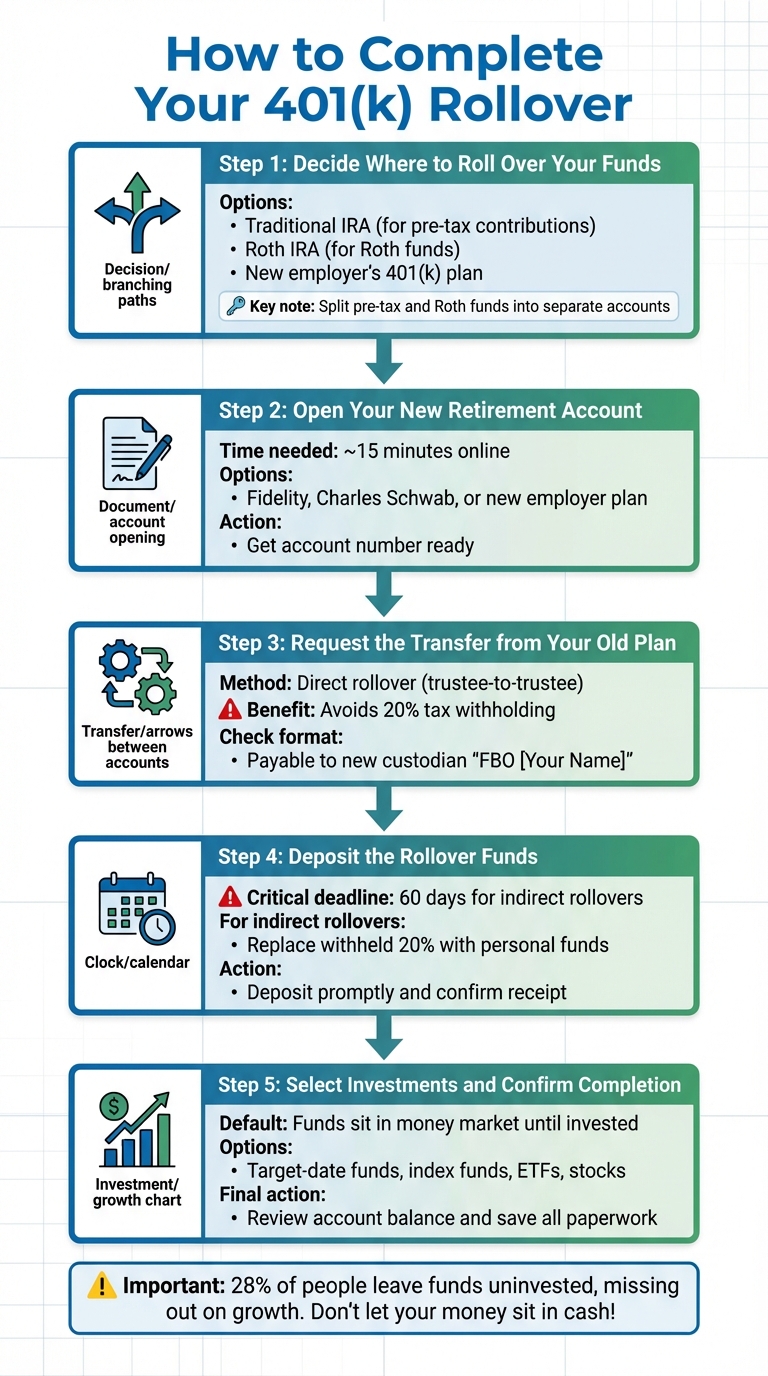
5-Step 401(k) Rollover Process Guide
Step 1: Decide Where to Roll Over Your Funds
The first step is figuring out where your money should go. If your old 401(k) consists only of pre-tax contributions, a Traditional IRA could be a good fit - it allows your money to grow tax-deferred until you withdraw it in retirement, at which point you'll pay income taxes. If your 401(k) includes both pre-tax and Roth funds, you'll need to split these into a Traditional IRA and a Roth IRA, respectively, as mentioned earlier. High earners who plan on using the "backdoor Roth" strategy might want to roll their funds into a new employer's 401(k) instead, as existing IRA balances can complicate this process. Alternatively, if you prefer keeping all your retirement savings in one place, rolling into your new employer's 401(k) plan is another option - just make sure their plan accepts rollovers from other 401(k), 403(b), or 457(b) plans. Once you've made your decision, you can move on to opening the new account.
Step 2: Open Your New Retirement Account
Before reaching out to your old plan administrator, set up your new account. If you're opting for a rollover IRA, companies like Fidelity and Charles Schwab make it easy. They even have physical locations in the Dallas area where you can handle the paperwork in person. Prefer convenience? You can open an account online in about 15 minutes. For those transferring funds to a new employer's 401(k) - such as the City of Dallas plan managed by Fidelity - check with your HR department to confirm the enrollment process. Once your account is set up, make sure you have the account number handy before moving to the next step.
Step 3: Request the Transfer from Your Old Plan
Now, it's time to contact the administrator of your old 401(k) plan and request a direct rollover. This method ensures the funds are transferred directly to your new account, helping you avoid the 20% mandatory tax withholding that applies to indirect rollovers. You'll need to provide your new account number and specify whether you prefer a trustee-to-trustee transfer or a check sent to you. If a check is issued, make sure it’s payable to your new custodian with "FBO [Your Name]" included. Some providers may require a Letter of Acceptance (LOA) from your new custodian before they release the funds, so it's smart to ask about this upfront. Following IRS guidelines is critical to keep your rollover compliant.
"A distribution sent to you in the form of a check payable to the receiving plan or IRA is not subject to withholding." - IRS
Step 4: Deposit the Rollover Funds
If your old plan sends the check directly to your new custodian, you just need to wait for confirmation that the funds have been received. However, if the check is sent to you, deposit it promptly - either in person or via mobile apps - to meet the 60-day deadline. For indirect rollovers where 20% was withheld, you’ll need to replace that amount with your own money when depositing to ensure the entire rollover stays tax-free. After depositing, you can move on to selecting your investments.
"If you miss the 60-day deadline, the amount will be treated as a taxable distribution, and you may also be subject to an early withdrawal penalty if you are under 59½." - Beacon Financial Group
Step 5: Select Investments and Confirm Completion
Once your funds are in the new account, they'll typically sit in a settlement or money market fund until you decide how to invest them. Log in to your account and choose from options like target-date funds, index funds, ETFs, or individual stocks, depending on your retirement goals and risk tolerance. Not sure where to start? For example, the City of Dallas 401(k) Plan offers Fidelity Freedom® Fund target-date options that automatically adjust as your retirement date approaches. Finally, confirm the rollover is complete by reviewing your account balance and transaction history. Keep all related paperwork - statements from both accounts and any tax forms - for your records in case the IRS requests documentation.
sbb-itb-bbaa742
Dallas and Rockwall Resources for Your Rollover
Tap into the expertise of local professionals in Dallas and Rockwall to handle your rollover with ease and confidence.
Finding Local Financial Advisors and Banks
The Dallas and Rockwall areas are home to several highly regarded fee-only fiduciary advisors who specialize in 401(k) rollovers. In Rockwall, Rockwall Wealth Advisors stands out with excellent reviews and offers a free consultation to get you started. Another option is Crestview Wealth Management, which provides a "Clear Path Consultation" for individuals approaching retirement, focusing on IRA rollovers, Roth conversions, and pension planning. Additionally, Mercer Advisors, serving the community since 2016, specializes in tax optimization and deferred compensation plans.
In Dallas, Correct Capital Wealth Management oversees more than $230 million in total plan assets, offering retirement plan consulting for both individuals and businesses. Meanwhile, DFW Retirement Planners, a trusted name since 2004, ensures your rollover aligns with IRS regulations. They emphasize their expertise, stating:
"DFW Retirement Planners are your premier IRA and 401k rollover experts and we'll help make sure that your rollovers are handled properly so that you can continue to receive the tax benefits that you've become accustomed to".
For Rockwall residents, RockwallConnect.com is a helpful resource, offering a directory of financial advisors and CPAs in the area. These local experts can guide you through the process, complementing the administrative steps explained earlier.
When to Get In-Person Help
Certain rollover situations call for direct, in-person assistance. If you’re juggling multiple 401(k) accounts from past employers, need guidance on handling company stock with specific tax implications, or are preparing for retirement, local advisors can provide tailored solutions. These professionals bring years of experience working within Texas regulations and markets. When selecting an advisor, confirm their fiduciary status - fee-only advisors like Rockwall Wealth Advisors are required to act in your best interest and don’t earn commissions from product sales.
Another option in Dallas is Fontana Financial Planning, which specializes in explaining the tax implications of moving pre-tax accounts and executing Roth conversions, ensuring you make informed decisions.
Using Your Employer's Resources
Your employer can also be a valuable partner during the rollover process. Start with your Human Resources department, especially for employer-specific guidance. For example, employees in the City of Dallas 401(k) Plan managed by Fidelity should consult HR to review the plan’s Summary Plan Description before initiating a rollover. This document outlines key details and rules that might impact your transfer.
HR can also provide the necessary forms and clarify whether your new employer’s plan accepts rollovers from other types of plans, such as 403(b) or 457(b). Don’t overlook this step - it ensures that your rollover aligns with both your current and future financial goals.
Rules, Deadlines, and Mistakes to Avoid
Knowing the IRS rules and steering clear of common errors can help protect your retirement savings during a rollover.
Important IRS Rules and Deadlines
Direct transfers are often the easiest way to comply with IRS regulations, but it’s still crucial to understand the key rules no matter how you handle your rollover.
One of the most important deadlines is the 60-day rule for indirect rollovers. Once you receive your distribution check, you have 60 calendar days to deposit the funds into another qualified retirement account. If you miss this window, the entire distribution becomes taxable. Plus, if you’re under 59½, you’ll face an additional 10% early withdrawal penalty.
For indirect rollovers, the IRS requires that 20% of the distribution be withheld for federal taxes. To avoid immediate taxation, you’ll need to replace this withheld amount using personal funds during the rollover process. The good news? Once you successfully complete the rollover, the withheld amount will be credited back when you file your tax return.
The one-rollover-per-year rule is another critical guideline. This rule limits you to one indirect rollover across all your IRAs in any 12-month period. However, it doesn’t apply to direct trustee-to-trustee transfers or rollovers from a 401(k) to an IRA. If you miss the 60-day deadline, you may qualify for a waiver, but requesting a private letter ruling from the IRS can cost up to $10,000. Alternatively, if you have a valid reason - like a financial institution error or serious illness - you can use the IRS "Model Letter" for self-certification at no cost.
Understanding these rules can help you avoid costly mistakes. But it’s equally important to recognize common errors that could chip away at your retirement savings.
Common Rollover Errors
Here are some frequent missteps to watch out for - and how to avoid them:
Cashing out is perhaps the costliest mistake. Shockingly, about 42% of employees cash out their 401(k) when they change jobs, triggering taxes and penalties. For example, cashing out a $50,000 distribution before age 59½ could result in approximately $20,500 in taxes and penalties.
Another common error is leaving funds in cash after completing the transfer. Nearly 28% of people who move their savings into IRAs let the money sit in cash. This can be a costly oversight. Americans collectively miss out on an estimated $172 billion in potential growth each year by not investing their retirement funds. As Sham Ganglani, Director of Retirement Product Management at Fidelity Investments, puts it:
"Your rollover is not done until you invest your money. If you're not proactive, your retirement savings can inadvertently stay in cash".
Here’s a quick guide to avoiding these pitfalls:
| Common Mistake | Correct Action |
|---|---|
| Cashing out the check | Opt for a direct rollover to keep your funds tax-deferred |
| Missing the 60-day window | Use direct transfers or deposit funds immediately upon receipt |
| Depositing only 80% of the funds | Replace the withheld 20% with personal funds and deposit the full amount |
| Rolling over more than once a year | Stick to direct trustee-to-trustee transfers, which aren’t subject to the one-per-year limit |
| Ignoring 401(k) loans | Repay any outstanding loan balance before the rollover to avoid it being taxed as a distribution |
The consequences of mismanaging a rollover can be severe. For instance, in 2025, the estate of actor James Caan faced nearly $1 million in taxes and penalties due to a failed rollover that violated the "same property rule" and missed the 60-day deadline. Even though Texas residents don’t pay state income tax, federal penalties like these can still take a huge bite out of your retirement savings. By following these guidelines, you can ensure a smoother and penalty-free rollover process.
Conclusion
Rolling over a 401(k) can be a smooth process if you take the right steps. It involves deciding where to transfer your funds, setting up the new account, requesting a direct transfer to steer clear of the 20% withholding, depositing the funds, and choosing investments that suit your goals. Keep in mind, cashing out before the age of 59½ can lead to hefty taxes and penalties, significantly reducing your retirement savings. Working with a fiduciary advisor can make a big difference - 77% of retirement plan participants report feeling "extremely confident" about their financial decisions when guided by a professional.
"Securing a comfortable retirement means proactively diversifying your savings through plans like 401(k) and IRAs, carefully timing your social security benefits and considering long-term care planning".
For those in Dallas and Rockwall, local financial experts are available to help simplify the process. These professionals can ensure compliance with IRS regulations, confirm your vesting status, and guide you in reinvesting your funds effectively. Whether you need help coordinating between financial institutions, understanding tax perks specific to Texas, or navigating the paperwork, having access to local expertise can be a game-changer.
Once your transfer is complete, focus on selecting investments that align with your retirement timeline and risk tolerance. By following these steps, you can protect your savings and stay on track for a stable financial future.
For personalized assistance, visit RockwallConnect.com to connect with local professionals who can support your 401(k) rollover. A well-executed rollover can make all the difference for your retirement savings.
FAQs
What taxes should I consider when rolling over a 401(k) in Texas?
If you transfer your 401(k) directly into an IRA or another qualified retirement plan, you typically won't face any immediate tax issues. However, choosing an indirect rollover comes with a key requirement: you must deposit the funds into the new account within 60 days to steer clear of taxes and possible penalties. On the other hand, converting a traditional 401(k) to a Roth account will result in income taxes on the amount you convert. It’s always a good idea to check in with a financial advisor to make sure you’re following all tax rules correctly.
Should I roll over my 401(k) into a Traditional IRA or a Roth IRA?
Deciding whether to roll over your 401(k) into a Traditional IRA or a Roth IRA comes down to your current financial situation and long-term goals. Here's how they differ:
- A Traditional IRA lets your money grow tax-deferred. You won’t pay taxes on contributions now, but you’ll owe taxes when you withdraw funds during retirement.
- A Roth IRA works the opposite way. You pay taxes on contributions upfront, but your withdrawals in retirement will be completely tax-free.
To make the right choice, think about factors like your current tax bracket, what you expect your tax rate to be in the future, and whether you'd rather deal with taxes now or later. If you're feeling uncertain, it’s worth reaching out to a financial advisor in Dallas. They can guide you based on your specific financial situation and retirement goals.
What should I do if I receive a 401(k) distribution check?
If you’ve received a 401(k) distribution check, you have two primary ways to handle it: direct rollover or indirect rollover.
With a direct rollover, the process is straightforward and hassle-free. Simply contact your plan administrator and request that the funds be transferred directly to your new retirement account, like an IRA or your new employer’s plan. This option minimizes complications and ensures the money moves securely.
On the other hand, if you opt for an indirect rollover, you’ll need to act quickly. You must deposit the check into an IRA or another qualified retirement account within 60 days to avoid taxes and possible penalties. Make sure to complete any necessary paperwork and keep a detailed record of the transaction for your records.
If the process feels overwhelming or you’re unsure about the best approach, it’s worth reaching out to a financial advisor. They can provide personalized advice and help ensure everything is done correctly and in line with the rules.
Related Rockwall Businesses
-
Lead Fuel CRM
Your Entire Business in One App. Phone, email, text, invoicing, contracts, automation, AI, websites, funnels, reviews, s
-
PxlPerfect Designs
At PxlPerfect Designs, we believe in more than just websites and SEO - we believe in helping businesses grow, supporting
-
The Mailbox Marketplace
The Mailbox Marketplace is a locally owned advertising company created to help small businesses connect with customers i