Why Slate Roofing Lasts Over 100 Years
How natural slate's density, low water absorption, fire/UV resistance, and proper installation let roofs last 75–200+ years.
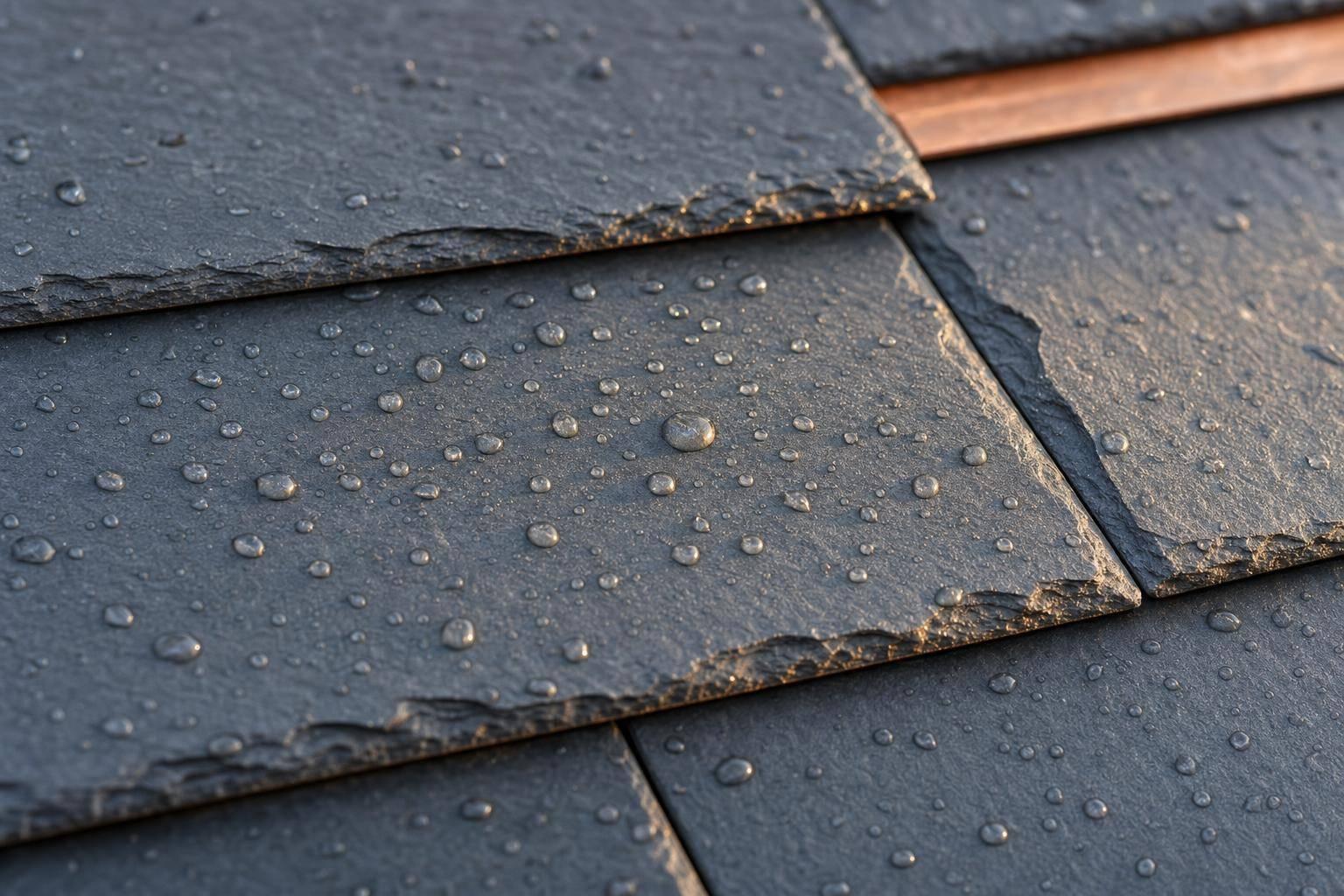
Why Slate Roofing Lasts Over 100 Years
A well-built natural slate roof can last 100 to 200+ years. That long life usually comes down to four things: dense stone, very low water absorption, strong weather resistance, and careful installation.
If I had to sum up the whole article in a few lines, it would be this:
- Natural slate is stone, not a factory-made roofing product.
- Top-grade slate can last 75–150+ years, and some roofs go past 200 years.
- Slate absorbs less than 0.4% water, which helps it resist freeze-thaw damage.
- It also handles UV, fire, hail, and wind better than many common roofing materials.
- In many cases, the stone outlasts the fasteners and flashing.
- A bad install can cut roof life from 100+ years down to a much shorter span.
- In places like Rockwall, TX, heat, hail, and wind put more stress on the whole roof system.
Here’s the plain-English version: slate lasts a long time because the material is tough, but the roof only reaches that kind of age if the nails, flashing, slope, framing, and repair work are done the right way.
| Factor | What it means for lifespan |
|---|---|
| Slate quality | Higher-grade slate lasts longer |
| Water absorption | Low absorption helps stop cracking |
| Weather resistance | Better performance in sun, fire, hail, and cold |
| Installation | Bad work can cause early failure |
| Maintenance | Small repairs help the roof last longer |
If you’re trying to understand why one slate roof lasts 40 years and another lasts more than a century, this is the answer: the stone matters, but the workmanship matters just as much.
Slate Roof Types, Cost and Lifespan
sbb-itb-bbaa742
Material science: the properties that make slate durable
Slate lasts for such a long time because the stone itself is built to resist water, heat, and slow decay from day one.
Dense structure and low porosity
Slate has a dense, layered structure, so there’s very little space for water to get in. It absorbs less than 0.4% of its weight in water. By comparison, unglazed clay tile can absorb up to 12.5% of its weight in water. That gap is a big deal. It makes slate much more resistant to frost damage and the freeze-thaw cycles that can crack more porous roofing materials.
"Also, when considering the material for use on a roof, one should note that slate has an extremely low water absorption index, less than 0.4%, which makes it resistant to frost damage." - Mark Chavez, National Park Service
That low absorption is one of the main reasons slate holds up so well over long periods of weathering. In a place like Rockwall, where heat and hail can hit a roof hard, that trait matters.
Mineral composition, fire resistance, and weather stability
Slate’s mineral makeup gives it hardness and natural cleavage, which lets it split into thin, flat shingles. It’s also naturally noncombustible, making it a strong pick for fire-resistant construction. On top of that, its mineral structure helps it stand up to UV exposure and chemical wear.
There is one catch. Calcite or pyrite impurities can react with moisture and lead to delamination. So the quarry source matters just as much as the slate’s grade.
"The estimated service life of slate shingles depends on the geology of the slate - its mineral composition, and the heat and pressure it was subjected to during its formation - a process known as metamorphosis." - Jeffrey Levine, Associate Principal, Wiss, Janney, Elstner Associates
Slate grades and expected service life
ASTM C406 grades slate based on strength, absorption, and acid resistance. S1 lasts the longest, while S2 and S3 come with shorter service lives. And not all quarried slate makes the cut. Only about 15% of slate extracted from a quarry is high enough in quality to become roofing shingles.
Those material traits sound good on paper. The real test comes when a roof has to face decades of weather, year after year.
How slate holds up against weather and time
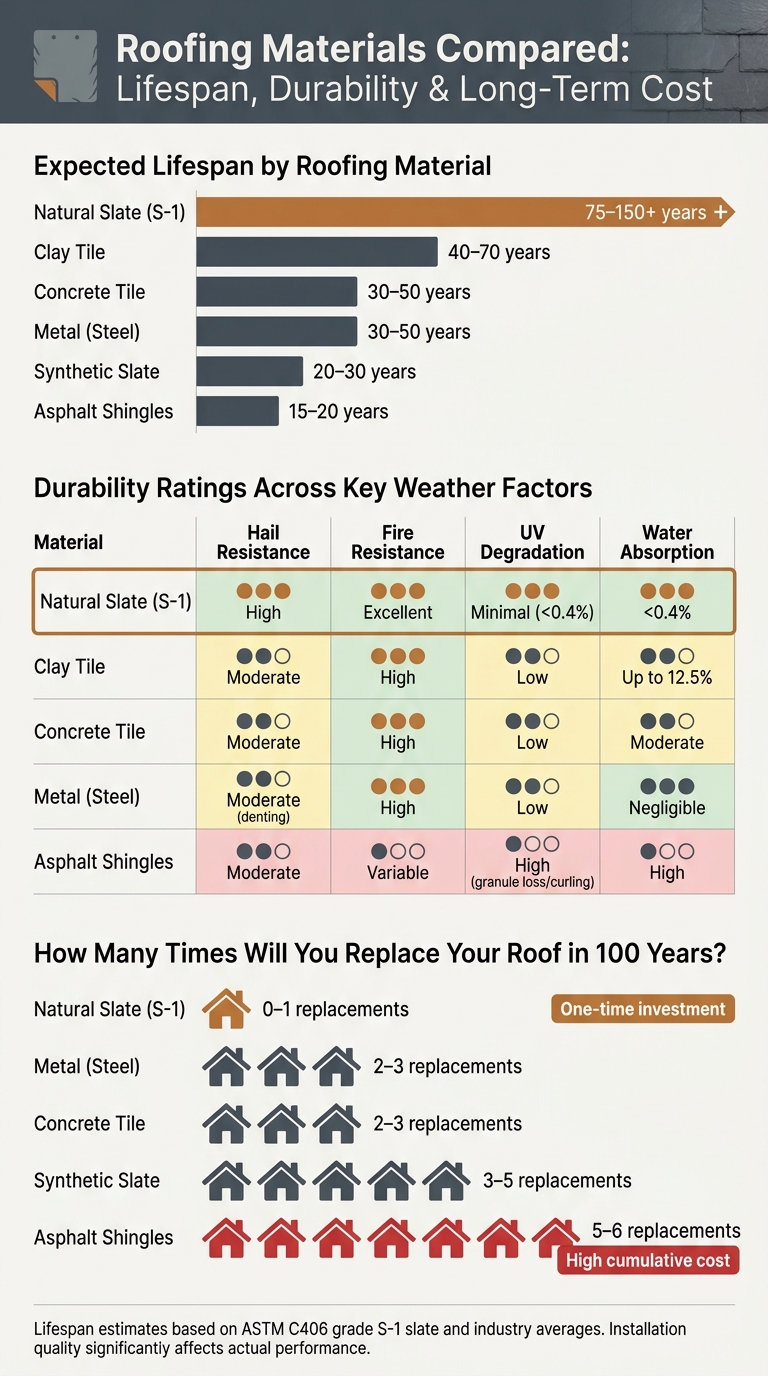
Roofing Materials Compared: Lifespan, Durability & Long-Term Cost
Those material traits matter most when a roof has to sit through decades of rain, hail, heat, and wind. That’s where slate starts to separate itself.
Water, freeze-thaw cycles, and UV exposure
Slate’s low porosity plays a big role in how long it lasts in the field. Because it takes in very little water, it’s less likely to crack when temperatures swing above and below freezing. It survives 50 freeze-thaw cycles at -20°C (-4°F) without damage.
Sunlight is another area where slate holds its ground. Slate is made of inert minerals - quartz, mica, and chlorite - that do not degrade chemically from sunlight or UV exposure. That gives it an edge over asphalt shingles, which tend to lose granules and curl over time as UV exposure wears them down.
Hail, wind, and fire performance
Slate’s density and compressive strength help it stand up to hail. Wind performance is a little more nuanced. The stone matters, of course, but installation matters just as much. S-1 grade slate has a breaking load of 575 lbf or greater, which helps it resist wind uplift when fastened correctly with copper or stainless steel nails. In high winds, fasteners usually fail before the slate does.
Fire is another strong point. Slate is naturally noncombustible, which makes it a strong choice for fire-resistant construction.
How slate compares to other common roofing materials
The lifespan gap between slate and most other roofing materials is hard to ignore. Asphalt shingles usually last 15–20 years before granule loss and curling make replacement necessary. Slate S-1 can last 75–150+ years.
| Material | Typical Lifespan | Hail Resistance | Fire Resistance | UV Degradation |
|---|---|---|---|---|
| Natural Slate (S-1) | 75–150+ years | High | Excellent | Minimal |
| Asphalt Shingles | 15–20 years | Moderate | Variable | High (granule loss/curling) |
| Concrete Tile | 30–50 years | Moderate | High | Low |
| Clay Tile | 40–70 years | Moderate | High | Low |
| Metal (Steel) | 30–50 years | Moderate (denting) | High | Low |
Of course, that long service life doesn’t happen by magic. A slate roof needs the right build, flashing, and fastening details if it’s going to perform like slate should.
Installation and maintenance: the gap between 40 years and 100+ years
Even S-1 slate can fail early if the structure, flashing, or fasteners are off. The stone may last for generations, but the roof system still has to be built the right way.
Structural support, slope, fasteners, and flashing
Slate is heavy. A typical slate roof weighs 7 to 8 pounds per square foot, so the framing needs to be designed for that load from the start.
Roof pitch also matters more than people think. It affects how long the slate stays wet, and wet slate weathers faster. The National Slate Association puts it plainly:
"The lower the slope of the roof, the greater the rate of weathering and deterioration as the slates tend to stay wet for a longer period of time."
A steep roof pitch, such as 14:12, moves water off fast and helps the slates dry out. A lower slope like 5:12 or 6:12 holds moisture longer, which speeds up delamination and cuts into the roof's service life.
For fasteners, copper slating nails are the standard when the goal is long service life. They don't corrode over a 100-year span. Nail placement matters too. If nails are set too shallow, they can wear the slate above. If they're driven too deep, they can crack the slate itself.
Flashing is another spot where shortcuts come back to bite later. Valleys, chimneys, and roof openings need long-lasting metals. As Mark Chavez of the National Park Service said:
"Given the permanence of slate, it is poor economy to use anything but the most durable of metals and the best workmanship for installing flashings."
Copper or lead-coated copper lines up well with the lifespan of slate. Lower-cost metals can rust out long before the stone does, and fixing that damage may mean taking apart large sections of the roof.
Once installation is done right, maintenance mostly comes down to protecting these same weak spots.
What routine slate roof maintenance looks like
Routine care focuses on the parts most likely to wear first. In most cases, slate roofs need small, focused repairs instead of a full tear-off.
The most common job is replacing individual broken slates. Gutters should stay clear, since clogs push more water toward the drip edge and speed up flashing wear. Flashing should also be checked for copper streaking, which can mean the metal is thinning and getting close to the end of its useful life.
One rule is simple: don't walk on a slate roof. Foot traffic can crack tiles. Pros use roof ladders so their weight is spread out safely.
During an inspection, each slate can be tapped. A clear ring usually means the stone is sound. A dull thud can point to weathering or layers starting to separate.
If 20% or more of the slates are broken, missing, or sliding, full replacement often makes more financial sense than continuing with one-off repairs.
Finding qualified slate roof contractors in Rockwall
Slate roofing is a niche trade. In many cases, the know-how is passed from one generation to the next instead of being taught in standard modern roofing apprenticeships.
In Rockwall, hail and wind tend to expose bad slate work fast. Poor installation can cut a roof's life short long before the stone itself wears out. Residents can use RockwallConnect.com, a local community hub and business directory, to find roofing companies serving the Rockwall, TX area, including contractors with experience in natural slate systems.
Before any work starts, ask for dated photos and a written condition report.
Long-term value, historic evidence, and key takeaways
Higher upfront cost, fewer replacements over time
Once a slate roof is installed the right way, the big question is simple: does the higher upfront price pay off later?
Over a 100-year span, natural slate often needs zero or just one replacement, while asphalt may need five or six. That changes the math in a big way. What looks expensive on day one can end up costing less across the life of the home.
Synthetic slate may sound like the cheaper path, but the gap is often smaller than people expect. The total initial cost is usually only slightly lower than natural slate because labor, flashing, and tear-off costs are nearly the same either way.
| Material | Expected Lifespan | Replacements Over 100 Years | Long-Term Cost Pattern |
|---|---|---|---|
| Natural Slate (S1) | 75–150+ years | 0–1 | One-time investment; extremely low lifecycle cost |
| Asphalt Shingles | 15–20 years | 5–6 | Low initial; high cumulative cost |
| Metal (Steel) | 30–50 years | 2–3 | Recurring moderate cost |
| Synthetic Slate | 20–30 years | 3–5 | Prone to UV degradation; recurring cost |
| Concrete Tile | 30–50 years | 2–3 | Frequent mid-life repairs |
What long-lasting slate roofs have in common
Historic roofs tell the same story again and again: slate keeps going when the weak points are looked after.
Archaeological excavations at Jamestown, Virginia, uncovered roofing slate dated to 1625–1650, which shows the material has been used since the earliest American colonial settlements.
In most cases, the slate itself is not what fails first. The usual weak links are fasteners and flashings. That’s why a roof’s lifespan depends on more than the stone alone. High-grade slate, correct detailing, and periodic attention to flashings and fasteners are what separate a roof that lasts a century from one that falls short.
The type of stone matters too. Peach Bottom slate from Pennsylvania and Maryland is estimated to last 200 years or more, while Buckingham slate from Virginia is estimated to last 175 years or more. Put plainly, installation matters a lot, but so does the quarry the slate came from.
The four reasons slate lasts so long
Slate lasts because four things work together:
- Metamorphic origin - Formed under intense heat and pressure, slate is dense, chemically inert, and made of stable minerals like quartz and mica that don’t break down over time.
- Low porosity - S-1 grade slate absorbs less than 0.4% water, which makes it highly resistant to frost and freeze-thaw damage.
- Fire and UV resistance - Unlike asphalt or synthetic products, slate doesn’t degrade under sunlight or heat.
- Proper installation - Corrosion-resistant fasteners and durable flashing help the roof last as long as the stone.
For many homeowners, slate is a long-term commitment - but it’s also the kind of roof that can keep paying back across generations.
FAQs
How can I tell if a slate roof is natural or synthetic?
It can be tough to tell at a glance, because some synthetic slate is made to look a lot like stone. One common clue is uniformity. If the roof looks too consistent in color, shape, or texture, it may be synthetic instead of natural slate.
Natural slate is a metamorphic rock, so it tends to have a layered look and a fairly flat surface. A visual check can point you in the right direction, but in many cases, confirming the material takes a pro’s eye.
Is my house strong enough to support a slate roof?
You’ll need a professional structural assessment to know for sure. Slate is much heavier than asphalt shingles, so your roof deck and framing need to handle that extra load without trouble.
A qualified structural engineer or experienced roofing contractor can inspect the rafters and sheathing to make sure they have the strength and condition needed to support the weight.
When should a slate roof be repaired instead of replaced?
Repair usually makes more sense when the damage is limited to a few parts, like broken slates, worn metal flashings, or loose fasteners. That lets you keep the roof’s historic character and the craft that went into it.
Replacement is often the better path when the slate itself is wearing out across the roof, with widespread crumbling, soft flaking, or severe delamination. If 20 percent or more of the shingles are failing, it’s time to get a professional evaluation.
Related Rockwall Businesses
-
Lead Fuel CRM
Your Entire Business in One App. Phone, email, text, invoicing, contracts, automation, AI, websites, funnels, reviews, s
-
PxlPerfect Designs
At PxlPerfect Designs, we believe in more than just websites and SEO - we believe in helping businesses grow, supporting
-
Cards on the Harbor
Cards on the Harbor is Rockwall's collector store for verified Pokemon singles, rare vintage foils, and factory-sealed b