5S Checklist for Small Business Owners
Simple 5S checklist for small businesses: Sort, Set in Order, Shine, Standardize, Sustain to save time and reduce hazards.
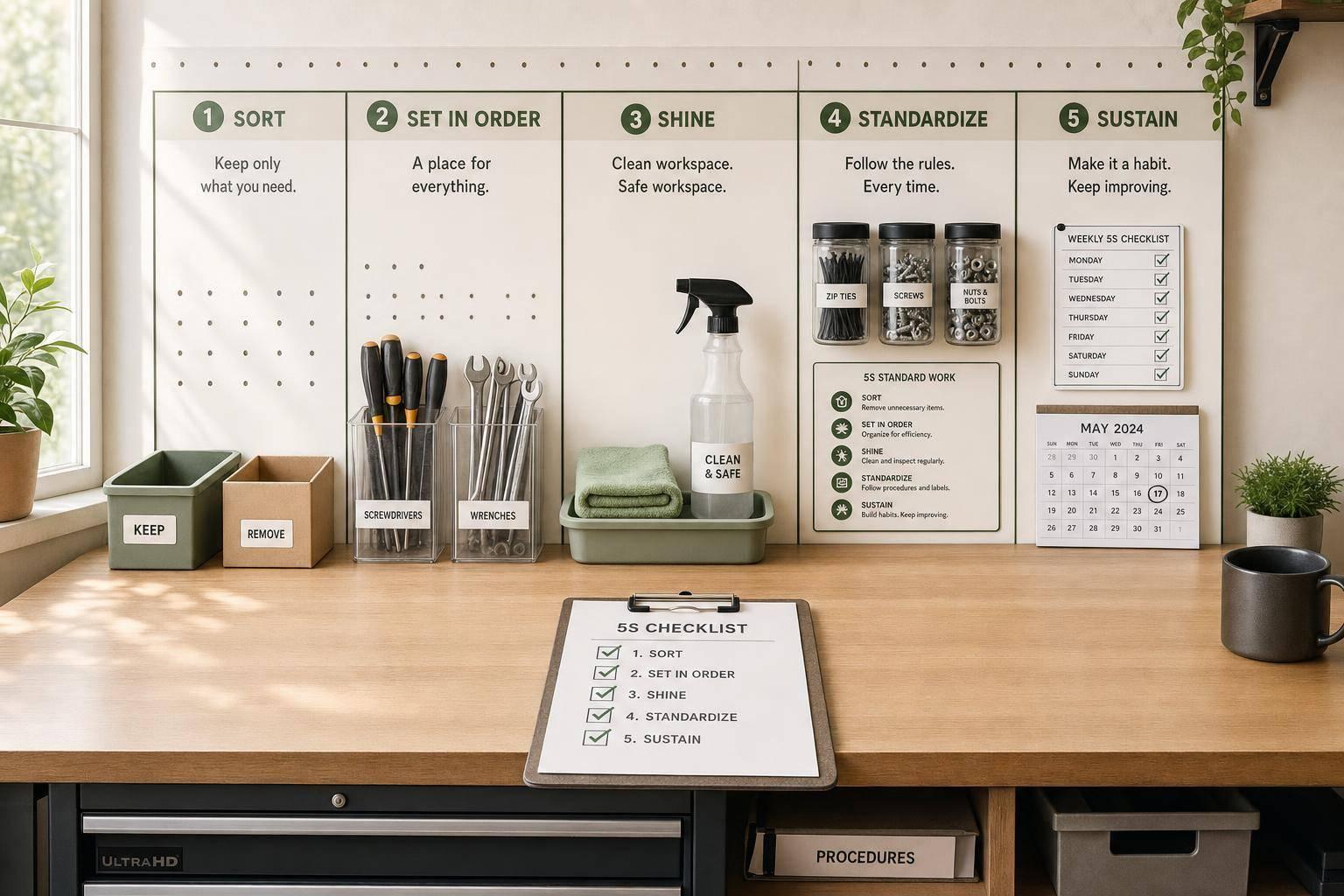
5S Checklist for Small Business Owners
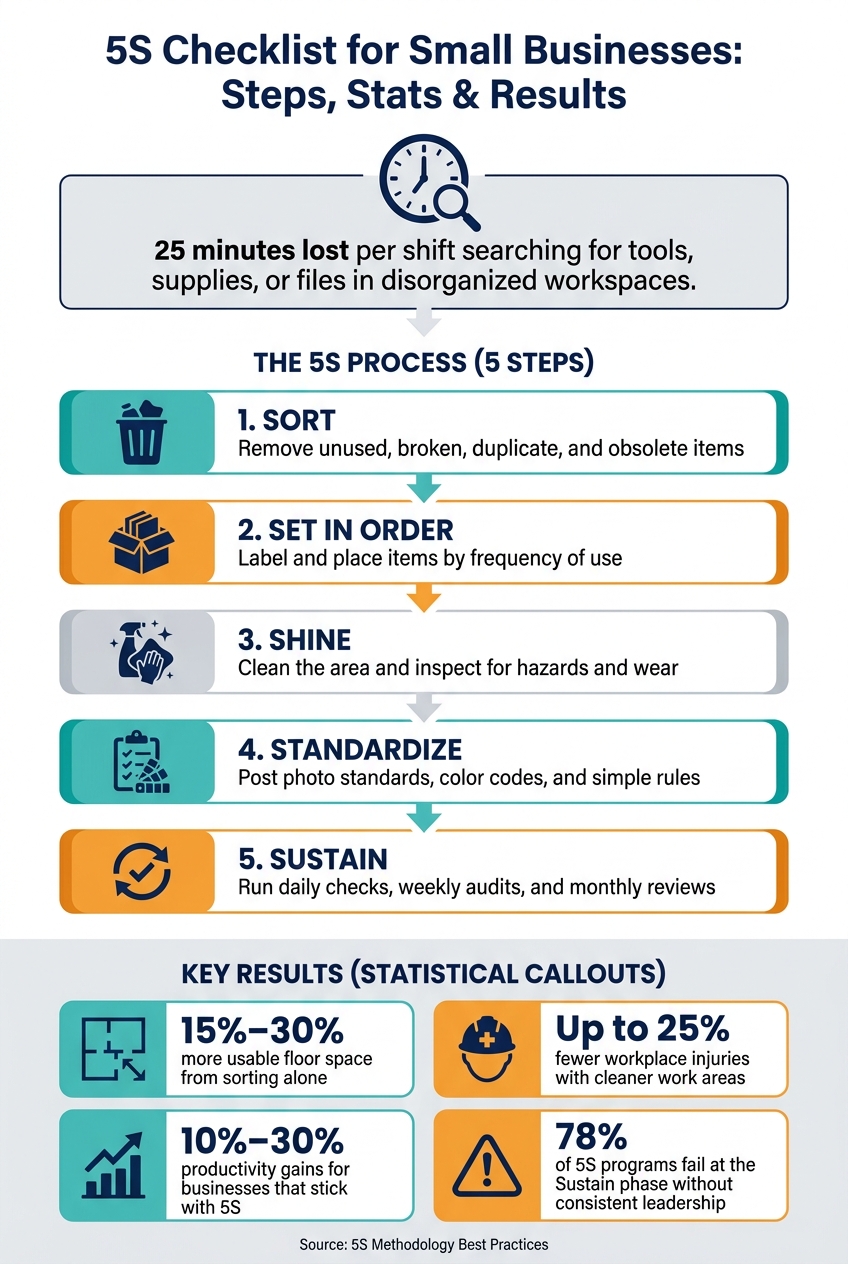
A messy work area costs time every day. In many workplaces, people lose about 25 minutes per 8-hour shift looking for tools, supplies, or files. A simple 5S checklist helps me cut that waste by giving each area a clear routine: Sort, Set in Order, Shine, Standardize, and Sustain.
Here’s the short version: I start with one problem spot, remove what isn’t needed, give the rest a fixed place, clean while checking for issues, write down the rules, and review the area on a set schedule. Done well, 5S can help cut search time, reduce downtime, free up space, and lower injury risk.
What this article covers:
- Sort: remove broken, old, unused, and duplicate items
- Set in Order: label and place items by how often they’re used
- Shine: clean the area and check for wear, leaks, cords, and hazards
- Standardize: use photos, labels, and simple rules
- Sustain: run daily checks, weekly audits, and monthly reviews
Key numbers to know:
- 25 minutes lost per shift from searching in disorganized spaces
- 15% to 30% more usable floor space can come from sorting alone
- Up to 25% fewer workplace injuries with cleaner, clearer work areas
- 10% to 30% productivity gains for businesses that stick with 5S
If I want a cleaner, safer, and less frustrating workplace, this checklist gives me a simple way to start.
5S Checklist for Small Businesses: Steps, Stats & Results
5S Steps 1 and 2 Checklist: Sort and Set in Order
Sort: Remove Unused Items, Old Stock, and Duplicate Supplies
Sort means removing anything that doesn't belong in day-to-day work. Start with the area you picked earlier, and finish clearing that space before you move to the next zone.
Take out anything that's unused, broken, expired, duplicated, or obsolete.
A simple place to begin is the Red Tag Method. Add a physical red tag to any item you haven't used in the last 30 days, and write down the date, item description, and why you're unsure about it.
Run Sort in three short sessions:
- Day 1 (15–30 minutes): Walk one zone and red-tag anything questionable.
- Day 2 (15 minutes per zone): Review tagged items with an owner and one employee. Give each item a decision: Keep, Relocate, Sell, Donate, Recycle, or Discard.
- Day 3: Move tagged items to a red-tag holding area and keep them there for 7–30 days before final disposal.
Use this table to move Day 2 along faster:
| Item Condition | Decision |
|---|---|
| Used daily | Keep - return to workspace |
| Used weekly | Relocate to within 10 steps |
| Used monthly | Relocate to central storage or high shelves |
| Broken, expired, or obsolete | Discard or Recycle |
| Duplicate or excess stock | Sell or Donate |
| Not used in 30 days | Red Tag Holding Area |
If a business has never done a formal cleanup, it's common to free up 15% to 30% of usable floor space during Sort alone. For Rockwall owners, RockwallConnect.com can help with donation, storage, or resale options.
Once the clutter is out of the way, give every item that's left a fixed home.
Set in Order: Label, Group, and Place Items by How Often You Use Them
Now that only the keepers remain, organize them by frequency of use.
Every item should have one permanent place.
Keep daily items within arm's reach. Put weekly items within 10 steps of the work area. Store monthly items in a central storage area or on high shelves. Then test the setup with the 30-second rule: anyone should be able to find, use, and return any item in under 30 seconds.
Label each shelf, drawer, and bin with the item name, standard quantity, and reorder point. A basic handheld label maker usually costs about $40 to $80, and shadow boards that show where each tool belongs usually cost about $50 to $150 per station. Use floor tape to mark zones clearly:
- Yellow for aisles
- White for workstations
- Red for scrap or red-tag areas
- Green for finished goods or safety equipment
The same idea works for digital files too. Delete duplicates, archive stale files, and use one naming format - such as YYYY-MM-DD_Client_Invoice# - so files are easy to find and return to later. The goal is simple: make it easier to put things back than to leave them out.
After placement is set, clean and inspect the space on a regular schedule.
sbb-itb-bbaa742
What is 5S Methodology? [DEFINITION + TIPS]
5S Step 3 Checklist: Clean and Inspect the Workspace
Once each item has a set home, the next job is to keep the space working day after day. That means cleaning on a set schedule and using that time to look for trouble.
Shine isn't just about making the area look neat. It's a simple inspection habit. As people clean, they can spot leaks, frayed cords, loose fasteners, worn belts, and other issues before those issues turn into downtime.
About 23% of unplanned equipment stoppages come from problems found during routine cleaning, such as leaks, loose fasteners, or worn belts. That alone makes Shine one of the easiest ways to catch problems early.
Daily and Weekly Cleaning Checklist
A tiered routine works best: daily, weekly, and monthly. Give each zone to a specific person so shared areas like restrooms and checkout counters don't slip through the cracks.
| Frequency | Who | Focus Areas |
|---|---|---|
| Daily (5 mins) | Operator / Frontline Staff | Wipe surfaces, sweep floors, empty waste, clear customer counters, check safety guards |
| Weekly (30 mins) | Supervisor / Team Lead | Clean equipment interiors, inspect electrical cords, check shelf stability, clean vents and filters, verify labels |
| Monthly (2 hrs) | Manager / Owner | Touch up floor markings, check lighting, audit for air leaks, test safety equipment |
Keep cleaning supplies at the point of use. If people have to hunt them down, the routine starts falling apart. Most small business spaces need $100 to $300 a month for cleaning supplies.
Inspection Checklist to Run While Cleaning
Cleaning time is also checkup time. Employees should look over equipment by touch, feel cords for excess heat, and note anything worn, missing, or out of place. The table below covers the areas that tend to cause the most trouble.
| Inspection Area | What to Look For | Why It Matters |
|---|---|---|
| Equipment | Leaks, oil residue, loose fasteners, worn belts | Prevents mechanical failure and unplanned downtime |
| Floors | Oil spills, debris, cracks, peeling floor tape | Reduces slip-and-fall risk |
| Workstations | Frayed cords, dust buildup, loose shelving | Catches fire hazards and ergonomic risks early |
| Lighting | Burnt-out bulbs, dust on fixtures | Maintains safe visibility |
| Storage/Shelves | Damaged packaging, missing tools, low supplies | Prevents inventory shortages and lost productivity |
If something gets flagged, log it right away. A paper form works. A free digital tool works too. Platforms like SafetyCulture offer free access for teams of up to 10 users.
One rule matters here: assign every issue to one person and give it a deadline. Don't leave it as a verbal note. If an inspection turns up something that needs a fast fix, Rockwall business owners can use RockwallConnect.com to find local maintenance, electrical, and cleaning help.
Log repeat issues now so Step 4 can turn them into simple standard routines.
5S Steps 4 and 5 Checklist: Standardize and Sustain
With Sort, Set in Order, and Shine in place, the hard part starts: keeping it that way. If you don't standardize the work, the gains from 5S can disappear fast. Steps 4 and 5 stop that backslide.
Standardize: Set Simple Rules, Take Photos, and Build Repeatable Routines
Take the problems you found during Shine and turn them into simple rules that stop those same problems from coming back.
Standardize means turning a clean, organized space into a visual system that anyone can follow, even a new hire on day one. One of the best tools for this is a One-Point Lesson (OPL): a one-page visual instruction sheet posted at the workstation. It should show photos of the ideal setup, a short checklist, and common mistakes to avoid.
A few simple rules help make 5S stick:
- Post the approved location for each item on the photo board. People should be able to see where something belongs without stopping to ask.
- Shift Handover Protocol: The outgoing shift leaves the area in 5S condition, and the incoming shift checks it within the first 5 minutes.
- Photo standards: Take clear photos of shelves, desks, and storage areas in their proper state, then post those photos nearby so problems stand out fast.
- Use the same color code on bins, labels, and floor markings in every zone so supplies stay where they belong.
Photos, labels, and matching colors make the standard state easy to see.
Sustain: Run Audits, Track Results, and Get Employees Involved
Once the standard is posted, you need a routine to protect it. That's where audits and simple scorekeeping come in.
Sustain is where many small businesses get stuck. In small factories, 78% of 5S implementations fail at this phase because leadership reinforcement is inconsistent. A fixed rhythm helps: daily 5-minute checks, weekly audits, and monthly management reviews. Owners or managers should also join audits at least twice a month so the team sees that 5S matters.
Use a simple 1–5 audit scoring system and post the scores where everyone can see them. A score of 4.0 or higher shows the system is working. Anything below 3.0 calls for immediate corrective action. If you spot faded labels, blocked aisles, or missing tools, flag them and assign same-day fixes.
| Metric | Target | What It Tells You |
|---|---|---|
| 5S Audit Score | 4.0+ out of 5.0 | Overall adherence to standards |
| Tool Search Time | Under 5 minutes per shift | How well Set in Order is holding |
| Unplanned Downtime | 20%+ reduction | Whether routine cleaning and inspection are catching issues |
| Near-Miss Reports | Logged consistently | Shows employees are spotting hazards early |
Use each score to assign one fix, one owner, and one deadline.
Less time spent searching, less unplanned downtime, and fewer repeat mistakes all lead straight to saved time and saved money. That's the core promise of 5S.
In Rockwall, it makes sense to schedule monthly audits before your busiest days so inventory and safety gaps show up early. Labeled reorder points on bins also make low stock easy to spot without digging through a spreadsheet.
To keep employees involved, tie audit scores to small team rewards, such as $50 to $100 per quarter. You can also place an index-card suggestion system at each workstation and review ideas within 48 hours.
Conclusion: Build a 5S Habit That Saves Time and Money
5S only works when it turns into a habit. Each step supports the next: Sort clears space for Set in Order, Shine helps your team catch problems early, and Standardize plus Sustain stop things from sliding back.
The best way to make it stick is simple: start small. Get one area stable first, then grow from there. Small businesses that stay with it can see productivity gains of 10% to 30%.
That’s why the routine matters more than the checklist itself. A checklist on its own won’t change much. Repetition will. Daily 5-minute checks, weekly cleanups, and monthly audits are what protect the work you put into the earlier steps.
When a 5S space is set up well, staff can spot issues fast. Labels are clear. Tools are in the right place. Everyone knows the routine. Day-to-day work feels smoother, and waste drops.
For Rockwall owners who want help keeping that system in place, RockwallConnect.com can help you find local cleaning, storage, and organization services as you build a stronger 5S routine.
FAQs
How do I start 5S in a small workspace?
Start with an initial audit so you can see your current setup clearly and spot what needs work.
Then move through the 5S steps:
- Sort by removing unused items
- Set in Order by giving each item a labeled home
- Shine by cleaning every day
- Standardize with simple rules
- Sustain through regular visual check-ins and steady discipline
It’s a straightforward process, but that’s the point. You clear out the clutter, make things easy to find, keep the area clean, and put basic rules in place so the system doesn’t fall apart a week later.
What if my team stops following the system?
If your team stops following the system, old habits are probably creeping back in because standardization or oversight has weakened. That’s why 5S should be treated as an ongoing way of working, not a one-time project.
Keep it in place with regular documented audits, clear task ownership, visible progress boards, and 5S scores built into performance metrics. Small rewards can help too. So can 5S training during onboarding, which gives new hires a clear sense of what “good” looks like from day one.
How much does 5S usually cost to set up?
There’s no fixed cost to set up 5S. What you spend depends on how much time, labor, and material you decide to put into the process.
The key is to work with the resources you already have and shape 5S around your workspace. Since 5S is built to reduce waste and improve efficiency, it can also help trim avoidable costs.
Related Rockwall Businesses
-
Lead Fuel CRM
Your Entire Business in One App. Phone, email, text, invoicing, contracts, automation, AI, websites, funnels, reviews, s
-
PxlPerfect Designs
At PxlPerfect Designs, we believe in more than just websites and SEO - we believe in helping businesses grow, supporting
-
Cards on the Harbor
Cards on the Harbor is Rockwall's collector store for verified Pokemon singles, rare vintage foils, and factory-sealed b